Why Gums Can Still Bleed When You Brush Twice a Day
Most of us brush the half of our mouth we can see. The research on where brushing misses is surprisingly consistent.


Pink in the sink after brushing is so common that most people stop noticing it. It is worth noticing. Bleeding gums are one of the earliest signs of gum inflammation, and the usual cause is plaque left sitting along the gum line.
What bleeding gums can mean
Dentists call early gum inflammation gingivitis. The 2017 World Workshop on periodontal diseases describes it as reversible once the inflammation is dealt with. It is also the stage that comes before periodontitis, a more serious condition and a major cause of tooth loss in adults.
Not everyone with gingivitis goes on to develop periodontitis, and there is currently no way to predict who will. That is why the same consensus treats managing gingivitis as a form of prevention.
If your gums bleed regularly, start with a dental visit. A toothbrush is not a treatment, and nothing on this page replaces someone looking in your mouth.
Where brushing usually misses
The plaque linked to gum inflammation collects at the gum line: the thin seam where tooth meets gum. Not the middle of the tooth. The seam.
And every tooth has two. One on the cheek side, which you see in the mirror. One on the tongue side, behind everything.
In that study, people were asked to get their teeth as clean as they could, with no time limit. 80% skipped at least one inner section entirely. Only one person out of 98 skipped an outer one.
A larger German study asked 2,595 people to do the same, then stained what was left. Between 44% and 52% of gum line sites still had plaque, with the back molars worst at 52% to 66%.
Harder and longer don't fix it
The instinct is to press harder. In a pressure study, force above roughly 150 grams removed almost no additional plaque.
The next instinct is to brush longer. In the filmed study, people averaged 206 seconds and still left plaque on 69% of their gum line.
Why nobody notices
People who had just brushed as well as they could estimated their gum line was about 70% clean. Measured, it was under 40%. The mint and the smooth feeling come from the outer surfaces, the part you did reach.
So this isn't about effort. It is about coverage: a small brush head, dozens of surfaces, an angle to hold, twice a day, with no feedback. People tend to miss in the same direction. The front gets the time. The back and inside don't.
What we designed around
Timers, pressure sensors and mapping apps all help you aim better. They still leave the aiming to you.
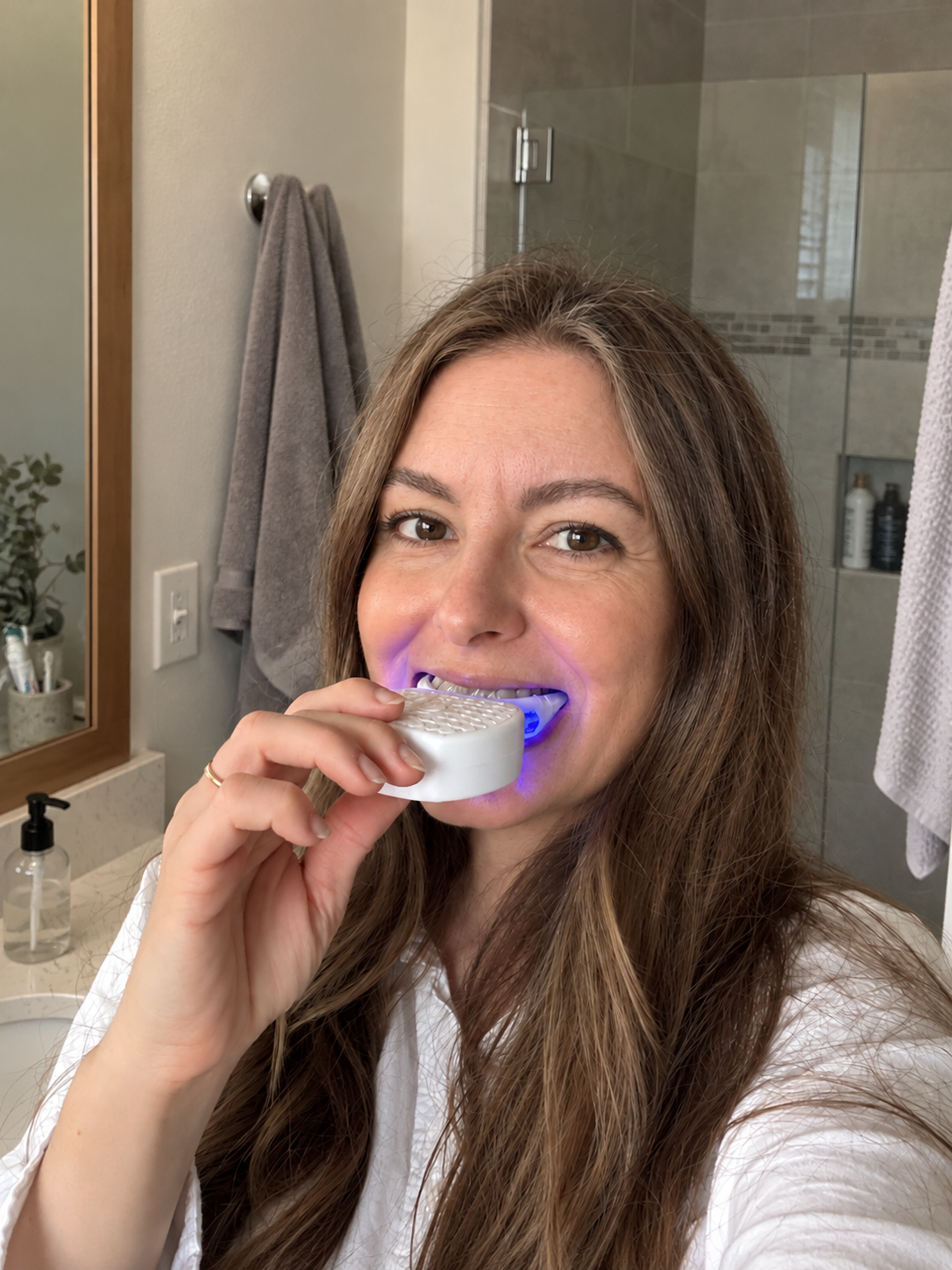
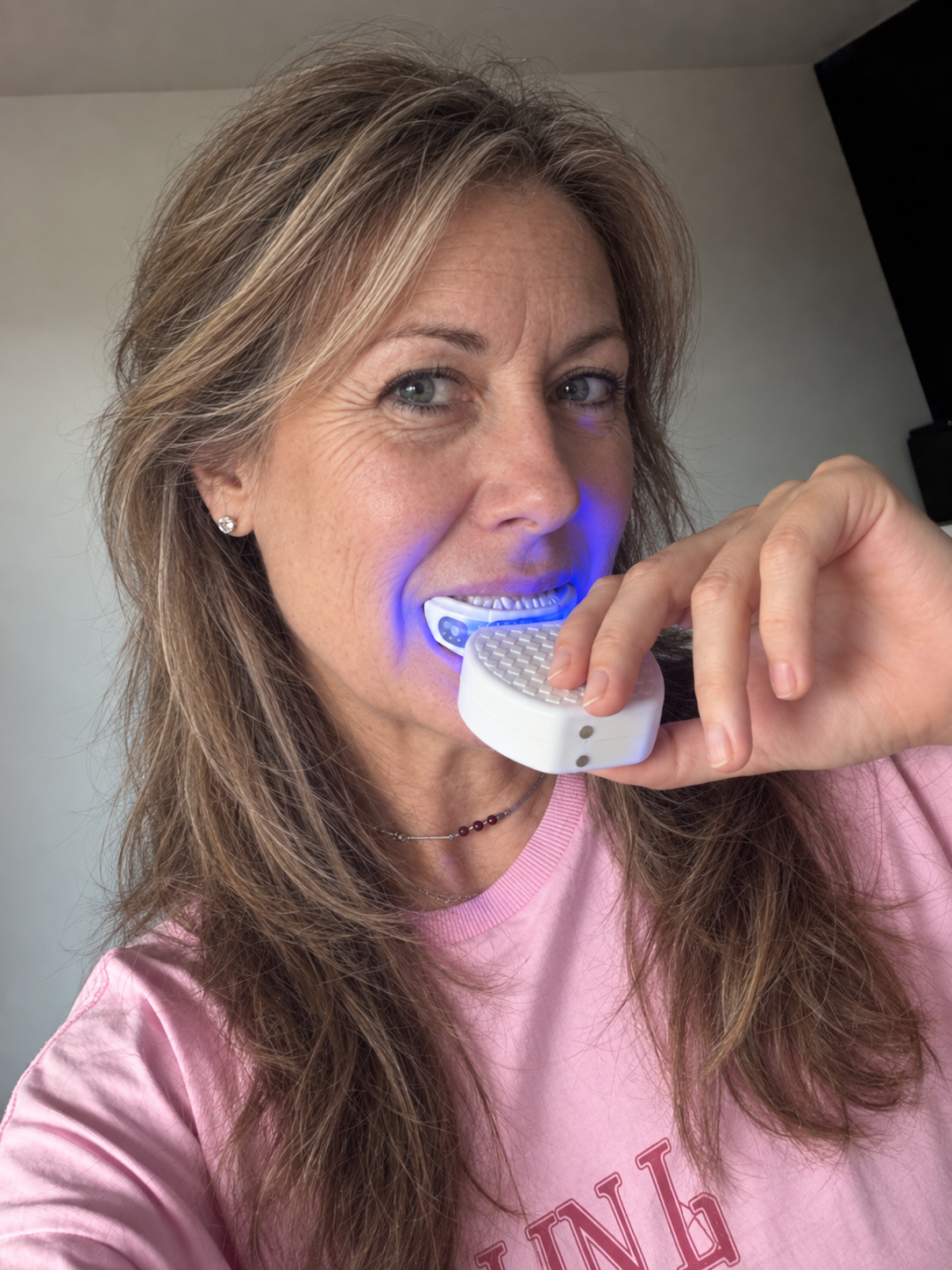
The Sonic Brush V6 Pro takes a different approach. You bite into a U-shaped mouthpiece that holds bristles against the outer surfaces, the inner surfaces and the tops of your teeth at the same time, for the whole cycle. There is no order to follow and no side to forget. The 45-degree angle to the gum line that dental guidance recommends is built into the mouthpiece, not left to your wrist.
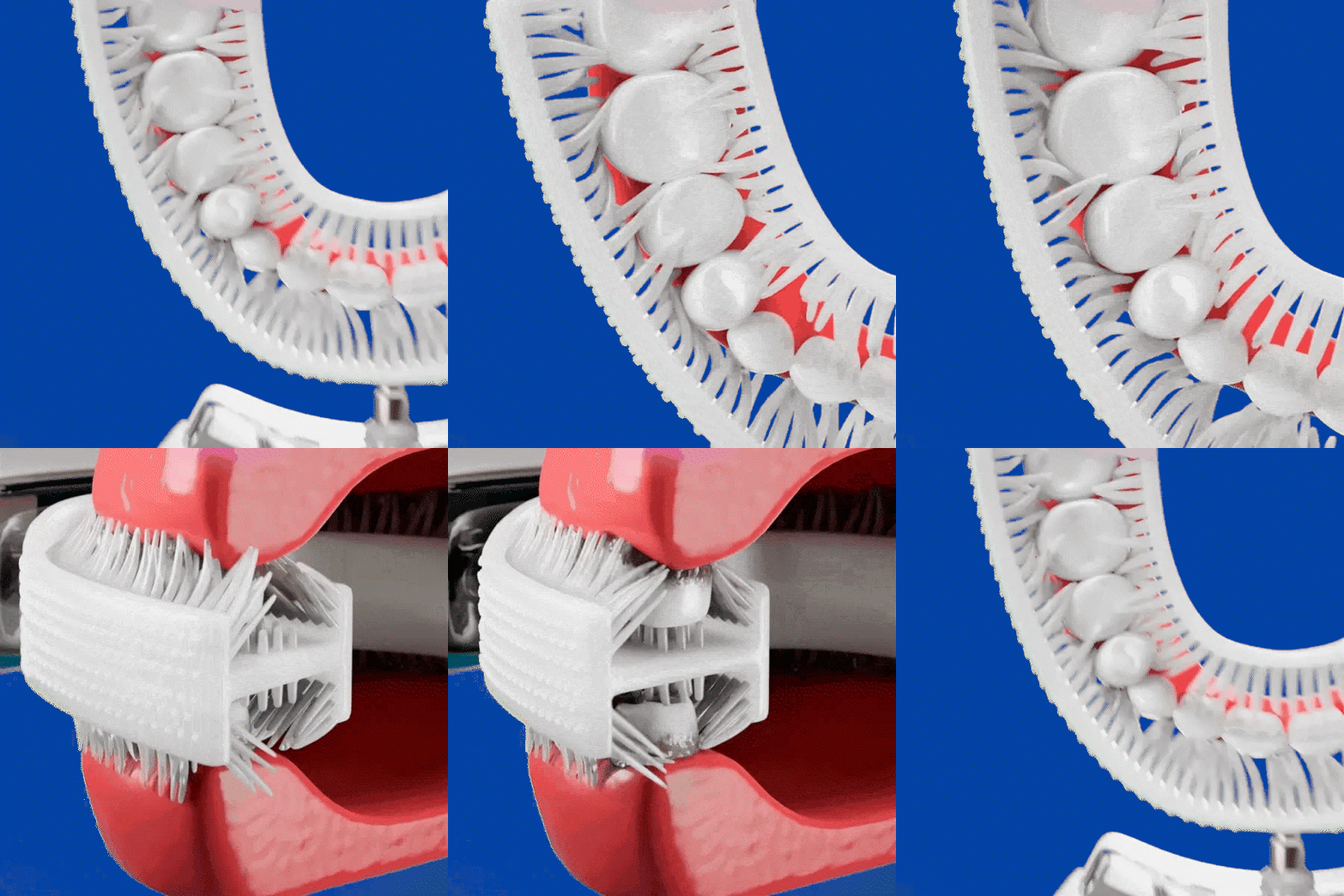
Bristles matter. A 2020 study of a U-shaped brush with soft silicone nubs found it did not remove significantly more plaque than not brushing at all. That is why the V6 Pro uses nylon bristles, not silicone.


Technique matters too. Use a small side-to-side movement during the cycle, and place dots of toothpaste along the top and bottom rows rather than one stripe. Most people get the hang of it in a couple of nights.
The Sonic Brush V6 Pro
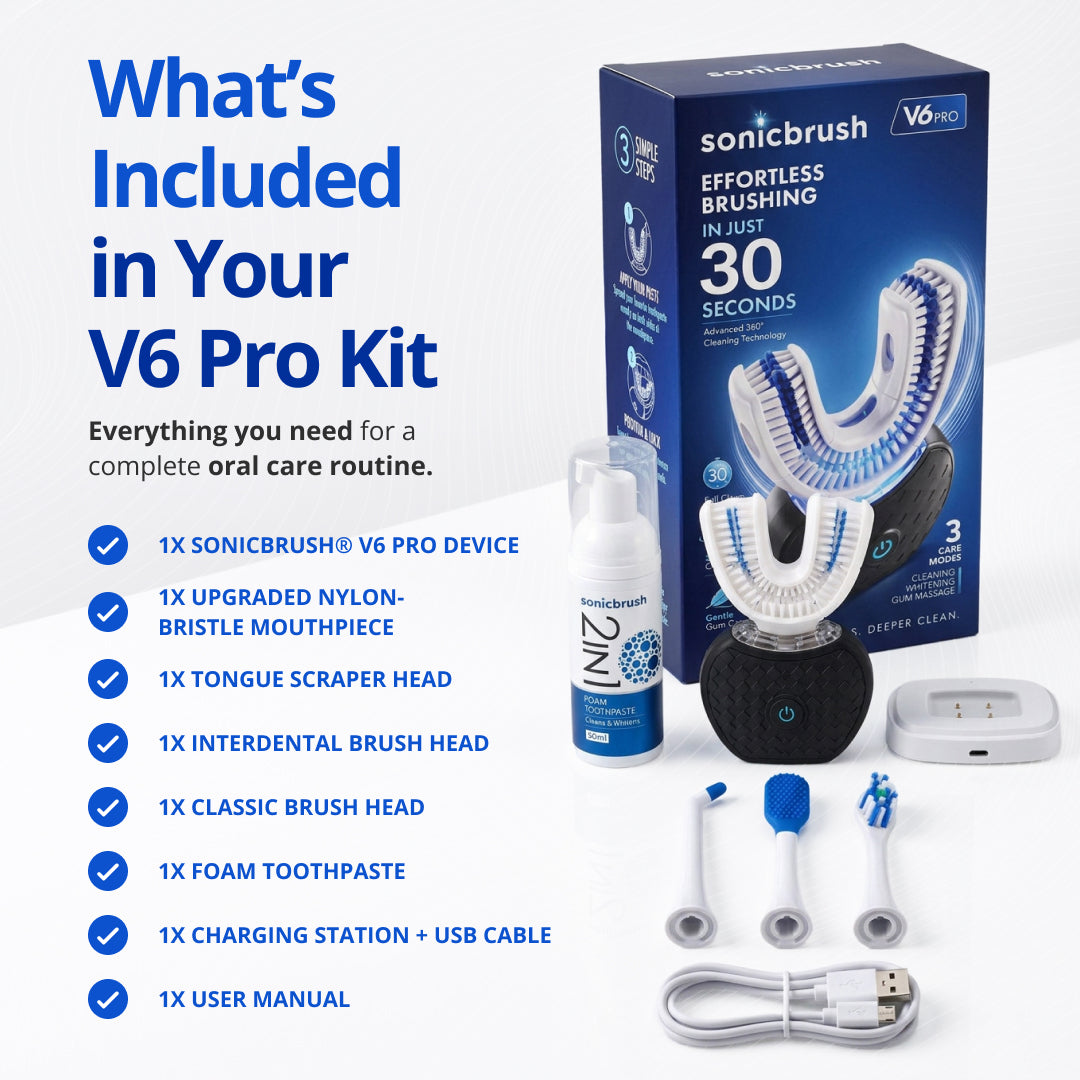
- Nylon bristles, set at 45 degrees to the gum line
- Inner and outer surfaces in contact at the same time, for the full cycle
- One press, 30 seconds, stops on its own
- 4-in-1: the handle also takes a classic brush head, a tongue scraper and an interdental head
★★★★★
"I've always had trouble with brushing too hard and for too short of time. This solves for everything."
Forest, Trustpilot
★★★★★
"It helps that you are hands free so while the brushing is taking place you can do something else."
June Z., Trustpilot, August 2026
Questions
Why not just buy a better electric brush?
A conventional electric brush still moves through your mouth a few teeth at a time, and you decide where it goes and for how long. Timers and apps help you aim. The mouthpiece is designed so there is nothing to aim: inner and outer surfaces are covered at the same time.
Is 30 seconds enough?
The V6 Pro is designed so the bristles stay in contact with the inner and outer surfaces together for the full 30-second cycle, rather than moving tooth by tooth. That is why the cycle is shorter. If you want extra time, run a second cycle, or use the classic head on any spot your dentist has flagged.
Will it fit my mouth?
The mouthpiece is flexible and comes in one adult size, which fits most adults. If it doesn't sit right, you have 30 days to return it.
What if I don't get on with it?
You have a 30-day return window, so you get a month of real use to decide.
My gums bleed when I brush. Am I brushing too hard?
Not necessarily. When you start cleaning areas that have been missed, some bleeding is common and is usually a sign of existing inflammation rather than damage. If bleeding continues for more than a couple of weeks, or comes with pain or swelling, see your dentist.
Does it replace flossing?
No. The box includes an interdental head and a tongue scraper, but neither replaces floss. Keep flossing.
I have crowns, implants or recent dental work.
Check with your dentist before using it, especially after recent surgery.
My gums bleed. Should I see a dentist?
Yes, especially if it has been going on for a while. A toothbrush is part of your daily routine between appointments, not a substitute for them.
The bottom line
Bleeding gums are not a sign you aren't trying hard enough. They are a sign plaque is sitting somewhere, and very often that somewhere is the side of your teeth you rarely brush on purpose. See your dentist, keep flossing, and choose a routine that reaches both sides every time.
Black November: the V6 Pro at its Black November price
One press, 30 seconds, inner and outer surfaces covered at the same time.

- Buy 1$79.992 free gifts included
- Most popularBuy 2$136.004 free gifts, save 15%
- Buy 3$180.006 free gifts, save 25%
- Nylon bristles at a fixed 45 degrees to the gum line
- One press, 30 seconds, stops on its own
- 4-in-1: automatic mouthpiece, classic head, tongue scraper, interdental head
Free shipping. 30-day returns. Ships in 1 to 3 business days.